비공식 자료, 책임 안 짐
이것은 양자물리 (학부용, Griffiths) 강의를 듣고 TA가 적은 필기입니다.
정리가 안 되어 있고, 개인적인 생각과 풀이가 섞여 있을 수도 있습니다.
교수님께서 검토하신 자료가 아니므로, 전문성을 보장하지 않습니다.
지난 강의
- 양자 필기 - Two-Fold Degenerate Perturbation Theory (Griffiths 7.2.1)
오늘의 핵심
Theorem
가 , 와 모두 commute하는 hermitian operator라고 하자. 만약 degenerate eigenfunction 가 의 eigenfunction이면서 서로 다른 eigenvalue를 가지면,
가 perturbation theory에 쓸 good states다.
위의 조건을 만족하는
위 theorem을 이후 강의 내용에서 계속 반복해서 쓸 것이다.
| Perturbation | 쓰는 operator | Good quantum numbers |
|---|---|---|
| Relativistic correction | ||
| Spin-orbit coupling | ||
| Weak-field Zeeman | ||
| Strong-field Zeeman의 fine structure 부분 | ||
| Hyperfine (ground state) | total spin | triplet / singlet |
기호 정리
| Symbol | Meaning |
|---|---|
| 함수를 반시계 방향으로 | |
필기 내용
1. 동기
지난 노트의 결론:
2. Theorem
Theorem
가 , 와 모두 commute하는 hermitian operator라고 하자. 만약 degenerate eigenfunction 가 의 eigenfunction이면서 서로 다른 eigenvalue를 가지면,
가 perturbation theory에 쓸 good states다.
3. Proof
좌변은
이 식은 모든
Good state는
이면 (5)에 의해 → good state는 이면 같은 논리로 good state는
Good states를 (degenerate subspace에서
4. Example 7.4: Example 7.2의 good states를 theorem으로 찾기
저번에 풀었던 아래 예시에 새로운 theorem을 적용해 보자.
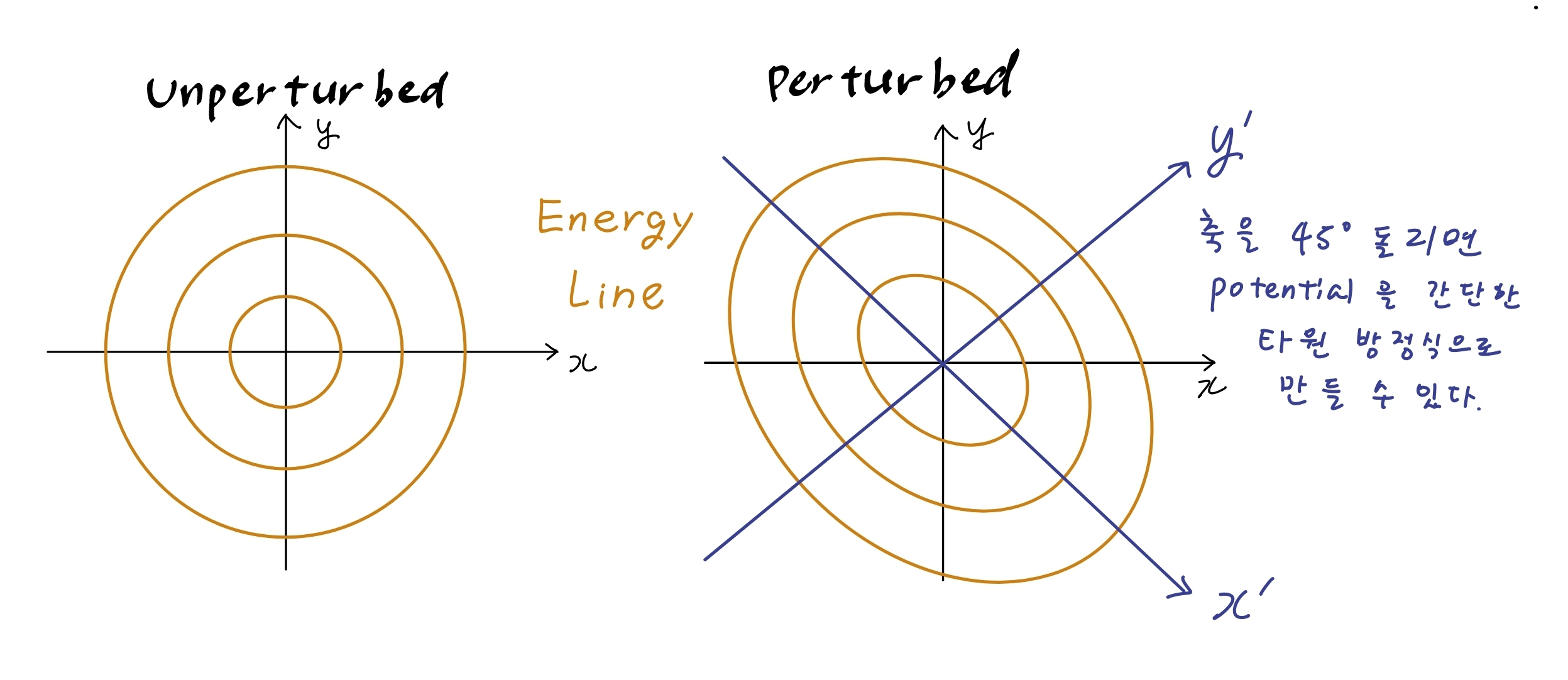
시도 1:
==둘 다 eigenvalue가
시도 2:
즉
Eigenvalue가
5. Moral
Moral
Degenerate state를 만나면,
와 모두와 commute하는 hermitian operator 를 찾아라. Unperturbed state로 와 의 simultaneous eigenfunction (단, distinct eigenvalue)을 고르고, ordinary first-order perturbation theory를 쓰면 된다. 그런 operator를 못 찾으면 를 직접 대각화해야 해야지 뭐… 어쩌겠어
대부분의 경우
Theorem이
대각화보다 더 강력한 이유 (footnote 7)
로 good states를 결정하려면 두 eigenvalue 가 달라야 한다. 어떤 경우에는 first order에서 같고 second, third, 혹은 더 높은 order에서야 갈라진다. 이때 는 good states를 알려 주지 못하지만, theorem은 모든 경우에 good states를 알려 준다.
6. 관련 연습문제
- Problem 7.9 (d): Bead on a ring + dimple 문제에서 theorem의 조건을 만족하는 hermitian operator
를 찾고, 와 의 simultaneous eigenstate가 (c)에서 쓴 good states와 같음을 보이기.
궁금한 내용
AI의 보충 설명
1. Theorem이
즉
지난 노트의 “운 좋은 경우
그렇다면…
이 경우를 잘 활용하는 것이 앞으로 배울 내용, ‘fine structure’와 ‘Zeeman efffect’이다.
2. 수소 원자 fine structure와 Zeeman effect에서의 적용 (7.3, 7.4 미리보기)
앞으로 배울 남은 chapter 7내용은 사실상 이 theorem을 반복 적용하는 과정이다.
| Perturbation | 쓰는 operator | Good quantum numbers |
|---|---|---|
| Relativistic correction | ||
| Spin-orbit coupling | ||
| Weak-field Zeeman | ||
| Strong-field Zeeman의 fine structure 부분 | ||
| Hyperfine (ground state) | total spin | triplet / singlet |
Operator 하나로 모든 state가 구별되지 않을 때는 여러 개의 commuting operator를 함께 써서 eigenvalue 조합이 모두 다르게 만들면 된다. 반대로 commuting operator를 다 써도 구별이 안 되는 state들이 남으면 (예: Stark effect에서
연관 학습 노트
- 양자물리 (학부용, Griffiths)
- 양자 필기 - Two-Fold Degenerate Perturbation Theory
- QM lecture note - Symmetry, Conservation Laws, and Degeneracy
- QM lecture note - Discrete Symmetries
- QM lecture note - Addition of Angular Momentum and CG Coefficients
References
- Griffiths, Introduction to Quantum Mechanics (3rd ed.), Section 7.2.2 (Theorem, Example 7.4, Moral), footnote 7, Problem 7.9
다음 강의
- 양자 필기 - Higher-Order Degeneracy (Griffiths 7.2.3)